–University Raised Record $312 Million in Philanthropic Support in 2026;
–$1 Billion Over Last Four Years
–Enrollment Grows 3.2% Year-Over-Year;
–Graduate Enrollment Surpasses Pre-Pandemic Levels
–Workforce Initiative CUNY Beyond Secures $4 Million Investment from The Ascendium Education Group and ECMC Foundation
Transcript from Address Available Online
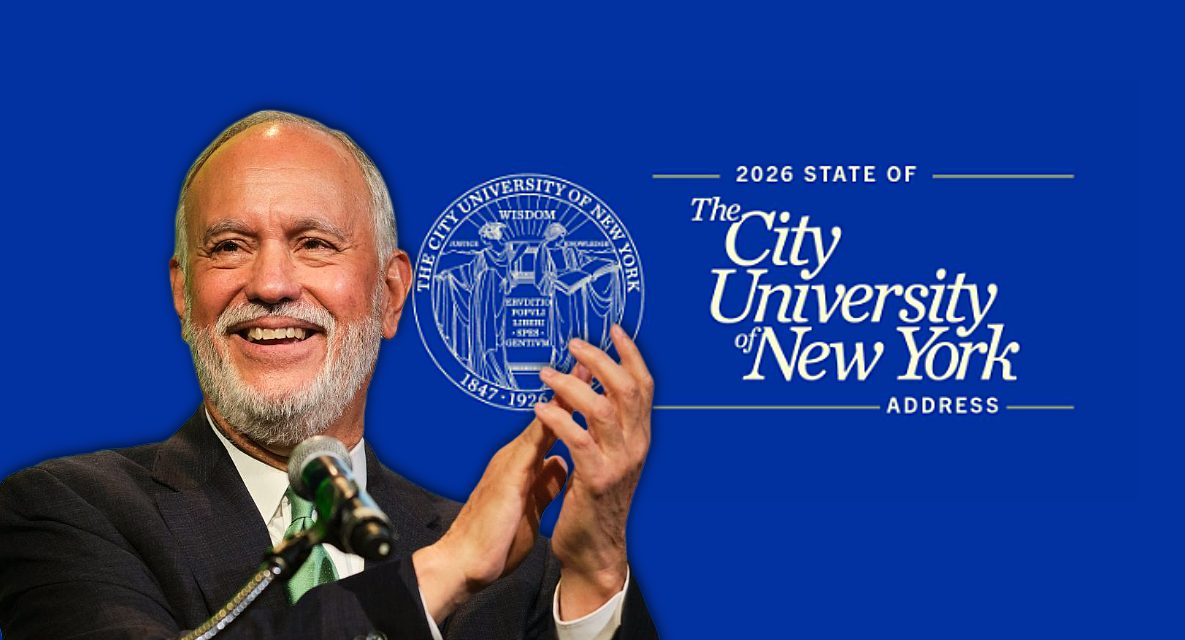
City University of New York Chancellor Félix V. Matos Rodríguez today delivered his State of the University address, announcing fundraising records, enrollment gains, and expanded career work in 2026. The University raised a record $312 million in philanthropic support during FY26, a 26% increase over the previous year. Over the last four years, the University raised $1 billion from foundations, corporations, alumni, and individual New Yorkers to support its mission of preparing students for academic and professional success.
“This year’s achievements reflect the extraordinary momentum taking shape across CUNY,” said CUNY Chancellor Matos Rodríguez. “More students are choosing CUNY because they see a pathway to opportunity, more employers are partnering with us to help students translate their education into rewarding careers, and more supporters are investing because they see the impact our graduates have. As we build on this progress, we remain committed to expanding access, strengthening student success, and preparing the next generation of New Yorkers to lead.”
The year’s largest donation was a historic $50 million gift from MacKenzie Scott to Lehman College, the single largest in the college’s history. In total, Scott has gifted nearly $130 million across five CUNY colleges. Another major gift was a $10 million donation from the Stone Foundation to expand the work of the Stone Center on Socio-Economic Inequality at The Graduate Center.
Growing Enrollment
In addition to record-breaking fundraising, the University posted enrollment gains for a fourth consecutive year, preliminary figures show. In his address, delivered at John Jay College, the Chancellor announced that enrollment rose 3.2% year-over-year. Notably, growth was broad-based: Community colleges grew 5% over the last year, while graduate enrollment topped 31,000, surpassing pre-pandemic levels and registering the second highest graduate enrollment in 13 years. Since 2022, system-wide enrollment has grown about 12%, reaching an expected 253,000 students.
The Chancellor pointed to CUNY’s strong partnerships with the State and City as a critical component of this success. New York state’s Reconnect program, launched by Governor Hochul last fall to provide free tuition for adult learners in high-demand fields, has enabled 9,786 students to enroll at CUNY.
Earlier this month, Chancellor Matos Rodríguez and NYC Public Schools Chancellor Samuels visited high school seniors taking courses at Borough of Manhattan Community College to distribute “Welcome to CUNY” letters. In addition to information about financial support available to students, the letters offer a reminder that CUNY is waiving its $65 freshman application fee through Nov. 16. The free application period, which began on Sept. 15, is part of Gov. Hochul’s College Application Initiative.
Expanding Career Success
The speech also saw the announcement of two new grants, totaling $4 million, to support CUNY Beyond. Unveiled during last year’s State of the University, CUNY Beyond is the Chancellor’s signature initiative to bring career preparation into the classroom. The new grants include:
- $3.25 million from Ascendium Education Group to help train faculty in career-connected learning and redesign orientation and first-year seminars for freshmen. Ascendium is a leading supporter of low-income learners.
- $750,000 from ECMC Foundation to strengthen advising services across multiple campuses. ECMC Foundation is a national nonprofit that supports innovative career success initiatives for underserved students.
This support, along with a $6.8 million investment by New York state, will enable Beyond to expand to five additional schools. Over the next year, these schools – Baruch College, City College of New York, Kingsborough Community College, Queensborough Community College, and York College – will integrate career counseling into existing academic advising, implement career maps that align academic degrees with professional milestones, and expand access to paid opportunities. To date, CUNY Beyond has grown to nine campuses encompassing 125,000 students.
Meeting Students’ Needs
The Chancellor also highlighted the impact of CUNY CARES, a pilot program designed to help students at the University’s three Bronx colleges access healthcare, mental health treatment, and food and housing assistance. Three years after its launch, CARES now reaches 7,500 students and initial results are promising:
- An 18% increase in SNAP enrollment between 2023 and 2025
- A 17% decrease in unmet mental health needs
- A 12% decrease in food insecurity
- A 5.3% decrease in housing instability
Now, thanks to a $900,000 investment from Robin Hood, CUNY is expanding the public benefits hub to two more campuses, the first step toward bringing it to all seven of its community colleges by 2028, starting with Queensborough Community College in January.
Other speech highlights include:
- $1 million in new support from the city to expand CUNY’s partnership with the Constructive Dialogue Institute to give students, faculty, staff, and campus leaders practical tools to navigate disagreement and conflict.
- An $18 million National Science Foundation award to CUNY researchers to build a new research platform that will combine artificial intelligence and robotics to accelerate the discovery of advanced materials.
- CUNY’s $555 million investment in capital projects – up from $346 million a year ago – allowing the University to complete 42 projects and make significant progress on system-wide efforts to modernize classrooms, laboratories, and critical campus infrastructure.
- CUNY has been upgrading the systems students, faculty, and staff rely on every day, with platforms like Brightspace and Slate that serve as digital online classrooms and making the University itself easier to run. CUNYBuy, a new centralized purchasing system, has cut procurement cycle times by 54% and is producing $7 million in annualized savings. And a new system, CAYUSE, is enhancing the administration and oversight of roughly $500 million a year in research grants.
Hear What People Are Saying
“CUNY continues to demonstrate why public higher education is one of New York’s most powerful engines of opportunity and economic mobility,” said Assemblymember Alicia Hyndman, Chair of the Assembly Higher Education Committee. “The growth in enrollment, historic fundraising, and expanded career opportunities reflect the University’s continued momentum. I look forward to working with Chancellor Matos Rodríguez to ensure more New Yorkers have access to an affordable, high-quality education and a pathway to success.”
“Students benefit when they can connect what they’re learning in the classroom to their career goals and see the steps they can take to reach them,” said Janice Hicks, strategy director at Ascendium. “We’re pleased to support CUNY Beyond as it helps faculty integrate career-connected learning into courses, helping more learners from low-income backgrounds prepare for meaningful careers.”
The City University of New York is the nation’s largest urban public university, a transformative engine of social mobility that is a critical component of the lifeblood of New York City. Founded in 1847 as the nation’s first free public institution of higher education, CUNY today has seven community colleges, 11 senior colleges, and eight honors, graduate, and professional institutions spread across New York City’s five boroughs, serving 247,000 undergraduate and graduate students and awarding 50,000 degrees each year. CUNY’s mix of quality and affordability propels almost six times as many low-income students into the middle class and beyond as all the Ivy League colleges combined. More than 80 percent of the University’s graduates stay in New York, contributing to all aspects of the City’s economic, civic, and cultural life, and diversifying the City’s workforce in every sector. CUNY’s graduates and faculty have received many prestigious honors, including 13 Nobel Prizes and 26 MacArthur “genius” grants. The University’s historic mission continues to this day: provide a first-rate public education to all students, regardless of means or background. To learn more about CUNY, go online.
By CUNY Communications