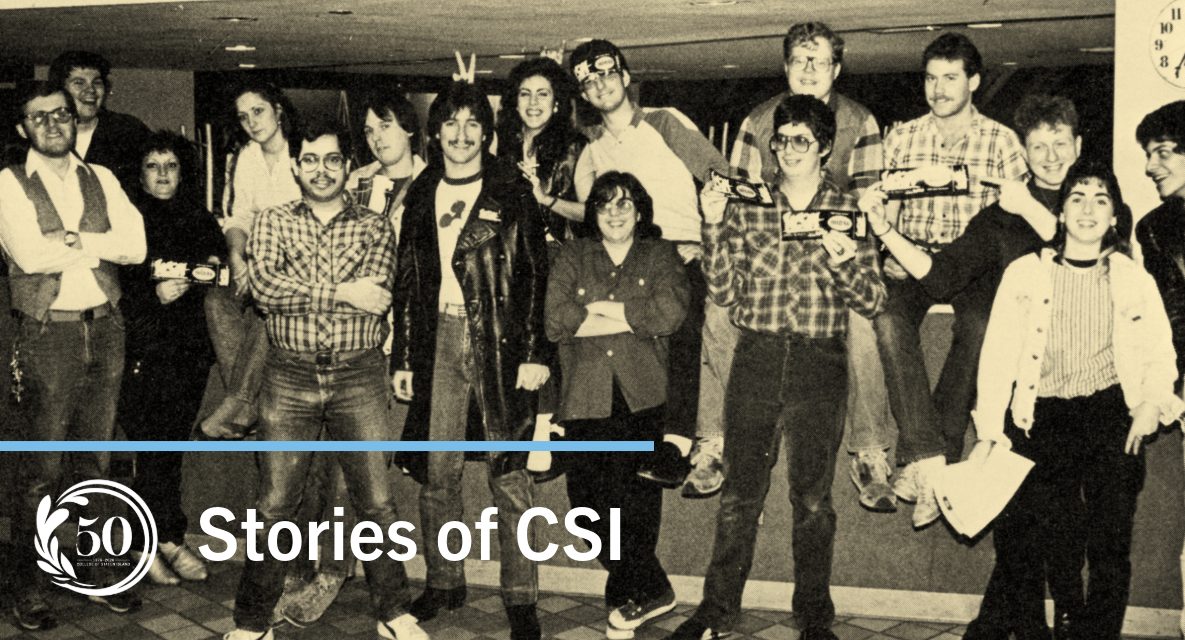
On August 31, 1981, a transmitter switch was flipped on Todt Hill on Staten Island, and 88.9 FM came alive with the sound of “A Long Time Gone” from Crosby, Stills, and Nash.
The song’s first line, “It’s been a long time comin’,” was the perfect description of a years-long tireless and passionate process to transform the College of Staten Island’s off-air radio station club into a bona fide on-air force on the FM band, serving the College and the Staten Island communities. Since then, many students have been a part of the station, learning the ropes of the various aspects of radio but at the same time, acquiring life skills like responsibility, confidence, and the ability to think on their feet in the face of adversity.
The Early Years
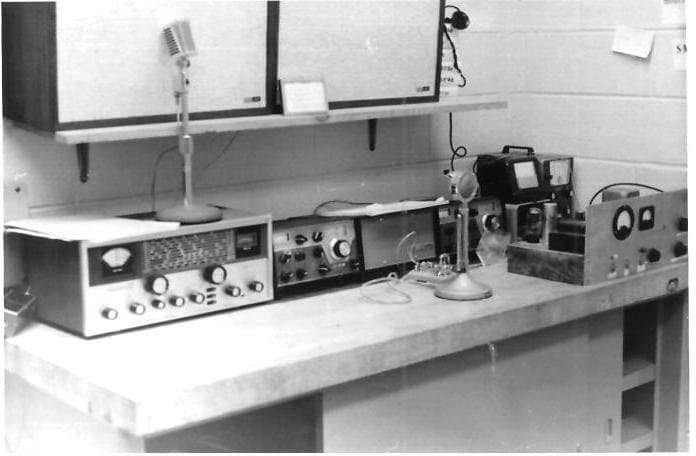
The CSI Association’s Marianne McLaughlin, who was a Staten Island Community College (SICC), one of CSI’s precursor institutions, in 1972 remembers at that time that students who were radio enthusiasts had a club, WVSI, that operated in a coat check room on the SICC campus. The room had a Dutch door, so WVSI staff would open the top half of the door, place a speaker on top of the bottom half, and play music into the hall. The makeshift operation eventually received clearance to send its audio into the cafeteria, greatly increasing its audience.
The Move from Off-Air Club to WSIA
Later that decade, Ron Resnick, a student at University of Colorado – Boulder, lived on Staten Island with his family when classes weren’t in session. Resnick was involved in radio at UC, but his work was in radio drama. When he was back in SI for vacation, a friend told him about CSI’s club, saying that he believed Resnick could turn the place around. He finished at UC and came back, registering at CSI. He went to the station to check it out. When Resnick knocked, Mark Sedutto, the club’s acting engineer, eyed him suspiciously. “Can I help you?” he asked. Resnick explained that he was looking for the radio station and Sedutto said that he found the place and then asked him who he was. Resnick said he was simply a student with an interest in radio. Once inside, he learned that students had ransacked the station over the previous year, stealing equipment and records, and even cutting the cable that fed the station’s audio to the cafeteria.
Trusting Resnick, Sedutto told him that the 88.9 frequency was the last one being offered in the area and that several schools were interested, underscoring the urgency of embarking on the project to apply for an FCC license. After Resnick heard the story about the demise of WVSI, he said he was instilled with an urge to make things right. Eventually, he partnered with Sedutto as station manager.
Resnick envisioned a Staten Island radio station catering to the entire community with a new format with blocks of musical genres. Resnick also decided to tap the Student Government (SG) and CSI Association for funding. Sedutto arranged for meetings with both bodies the following week. The two partners also agreed that the WVSI calls had to go to make a clean break with the old club’s tarnished past. They agreed on WSIA—the second and third call letters representing Staten Island and the fourth standing for the highest letter grade and A-1, the best.
The Approval Process
Resnick met with then-Director of Student Life Lorelei Stevens and after she heard his pitch, she decided to give them a shot. Resnick paraphrased what Stevens told him: “This College is going to need to have proof and you’re going to have to really show what you guys can do. And Ron, if you’re the guy who’s leading it, you’re going to have to show what you’re going to bring as value and how different you are than any other station that we had, especially the one that was here before this because there’s a really bad taste in my mouth now about this.”
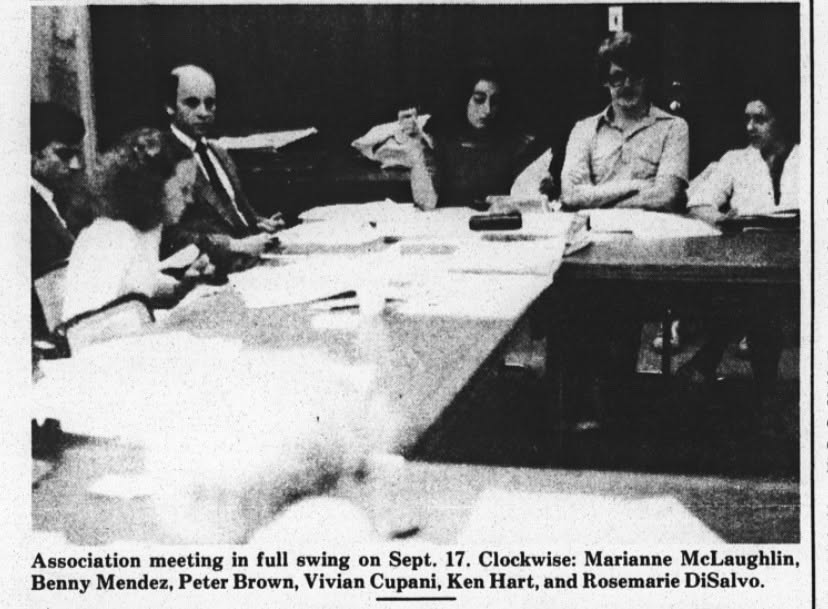
Under then Dean (of Students) Grace Patrone, a radio station advisory committee was also established to work toward putting the station on the air.
Resnick met with SG and said he was starting a station and was preparing a format, saying he’d come back when that was sorted out. They also wanted to see what he could bring to the table. At that point, he had a feeling that no one was on his side. He had two options: walk away or prove himself. He opted for the latter.
He recruited talent and formed a team that moved the project on. He also dealt with typical hurdles, such as student approval for intramurals to provide a percentage of the station’s funding. Eventually, after they secured the money, their next task was to find a professional Station Manager.
A New Manager and Technical Issues
It was a chance sighting of an advertisement in Broadcasting magazine that brought Dr. Greg Adamo, to WSIA as its first Station Manager. He opined that one of the reasons he got the job was that no one was willing to do the job for such a low salary. The appointment was only for a year. He said he was hired by the students “because the College had the license but didn’t have the money to buy the equipment, to pay for the engineer [eventually Bill Wells, Chief Engineer at WBAI], and to pay for a full-time manager to oversee the station. So that came out of student fees (through the SG) and the Association.”
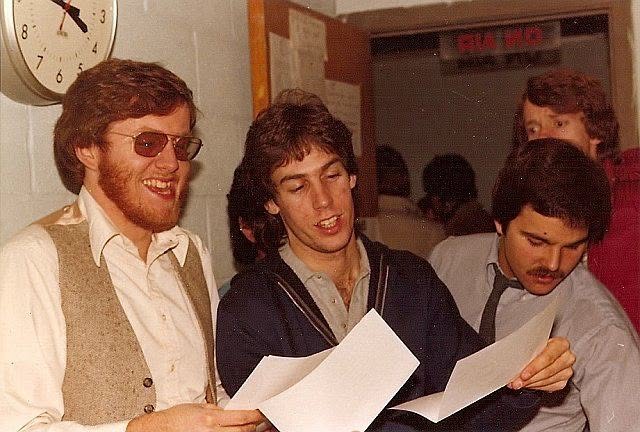
Dr. Adamo described how WSIA secured its tower location on Todt Hill, the highest point on the Eastern Seaboard. With only ten watts, it was imperative for the station to broadcast from Todt Hill because FM signals are line-of-sight. Therefore, the taller the tower, the stronger the signal. The tower was owned by the Archdiocese of New York. “I will never forget Sister Irene Fagazy,” he said. “She was the person in charge of the Archdiocese Instructional Television and her lawyer said, ‘Don’t let these students and the College have access to that tower.’ She overruled those lawyers and we got the tower. We then had to get phone lines to run up there, which was another challenge.”
As the hook-up process went on, he was the liaison between the College, the phone company for lines connecting the studios to the transmitter, and the Archdiocese that owned the tower, and he had to be there whenever anything was going on at the antenna.
Another player in the engineering process to bring the station on the air was Phil Wall, the station’s student engineer. At the time, he was an electro-mechanical engineering student and had no idea about what radio was or anything about music other than listening to commercial radio. “I’d seen a poster up on the wall inviting students to come join the radio station,” he noted, “and I thought ‘Well, that would be a good place to network with people. I’m kind of curious.’ I was interested in HAM radio, so I thought ‘let me go down there and see what that’s all about.’” In that role, Wall learned the skills he needed to eventually build a successful career as a broadcast engineer. Wall said that it took about two weeks to get things ready for broadcast.
“There wasn’t really a lot to do,” Wall recalled. “There were two control rooms, one was the on-air control room and the other was a production control room. Our priority was the on-air control room.”
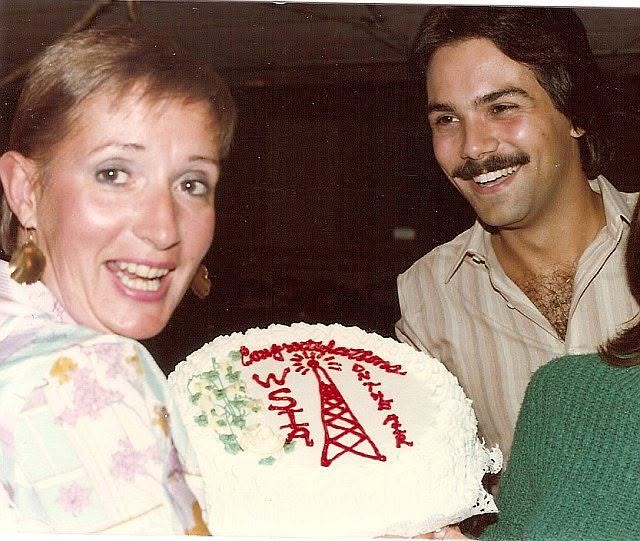
Eventually, with FCC license in hand, tower and broadcast equipment secured and hooked up, Adamo flipped the transmitter switch and Pat Crocitto, the announcer on the air, spun “A Long Time Gone.” WSIA was on the air!
Following the Rules and Creating On-Air Content
As Station Manager, Adamo had not only the responsibility of minding the transmitter, its tower, and the station’s connecting lines that fed WSIA’s audio to Todt Hill, he was also in charge of enforcing station and FCC rules, as well as honing a format.
Looking back on his days of keeping an eye on regulations, he said, “It was tough. It was stressful.” He compared the experience to some of the intense human interactions in The Bear, set in a restaurant kitchen. “We were so passionate about the station that there was a lot of arguing and yelling, not unprofessional, but it was very intense. There is a record over the years of college administrators [at other institutions] pushing out students to turn [college stations] into NPR stations and things like that. So, I prioritized the students but sometimes they didn’t see that. I had to prioritize the license and communicate to the College that the students were being responsible.”
Speaking of the format, Dr. Adamo stressed variety and inclusion in the music that the station aired. “We were on the cutting edge of a lot of diversity, playing World Music and things like that.”
“One of the ways I managed the station was that we were all learning, so I said to the students, ‘don’t just come in and play your favorite music; learn about music from around the world’.”
Kelly Hagstrand, one of the first crop of on-air announcers, also appreciated the human aspect of the station. “The people were all great. Everyone. Everyone on that station; there was not one bad person. They were all working for the same goal. They all worked hard and they had to play hard too.”
WSIA wasn’t all about the music, either. McLaughlin stressed that WSIA, like any radio station, was broken down into departments such as programming, news, sports (even broadcasting Dolphins games), underwriting (to secure funds for the station), engineering, and other critical areas. She said that whichever department students chose, they would receive training to ensure that they not only did their jobs effectively, but that they could carry these skills into their eventual careers.
Fond Memories
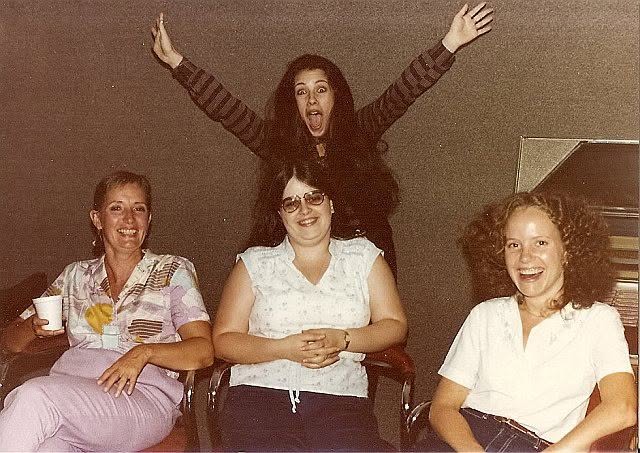
One of the reoccurring themes among WSIA alumni who CSI Today spoke with for this article was the strong interpersonal bonds that were forged among station staff—relationships that still carry on to this day.
Rosemarie DeSalvo, who went on to become a television writer and producer working on shows such as You Bet Your Life with Jay Leno, said she enjoyed the “camaraderie and the fun and going to conventions.” She noted that she made lifelong friends at WSIA. “It was really a great experience doing live radio because things are happening, you’re constantly thinking on your feet.” She felt her experience gave her skills to handle life’s unexpected turns.
Dr. Adamo backs her up, saying what mattered to him most were “the students who came together and put it on the air and kept it going.”
Today and Beyond
Today, WSIA is still training the next generation of broadcast and communications professionals, but it is also providing these students with invaluable life skills that they will carry with them forever, whether they pursue a career in broadcasting or not.
Marianne McLaughlin summed up the significance of WSIA—beyond the content that broadcasts. “The learning that students get…so many [former members] have gone on to these incredible jobs that were connected to what they learned, not necessarily in the classroom, but at the radio station, supplemented by what they learned in the classroom.
“Unlike any student activity—I think each one has a value to students—but the radio station is the one that has the largest depth and breadth of possibility for enriching the lives of our students.”
To ensure that this enrichment and personal growth continue, Dr. Adamo has helped establish The WSIA-FM Scholarship Fund with the goal of raising $10,000. Learn more at the Fund’s GiveGab page.
By Terry Mares
[all images courtesy WSIA FM Facebook]