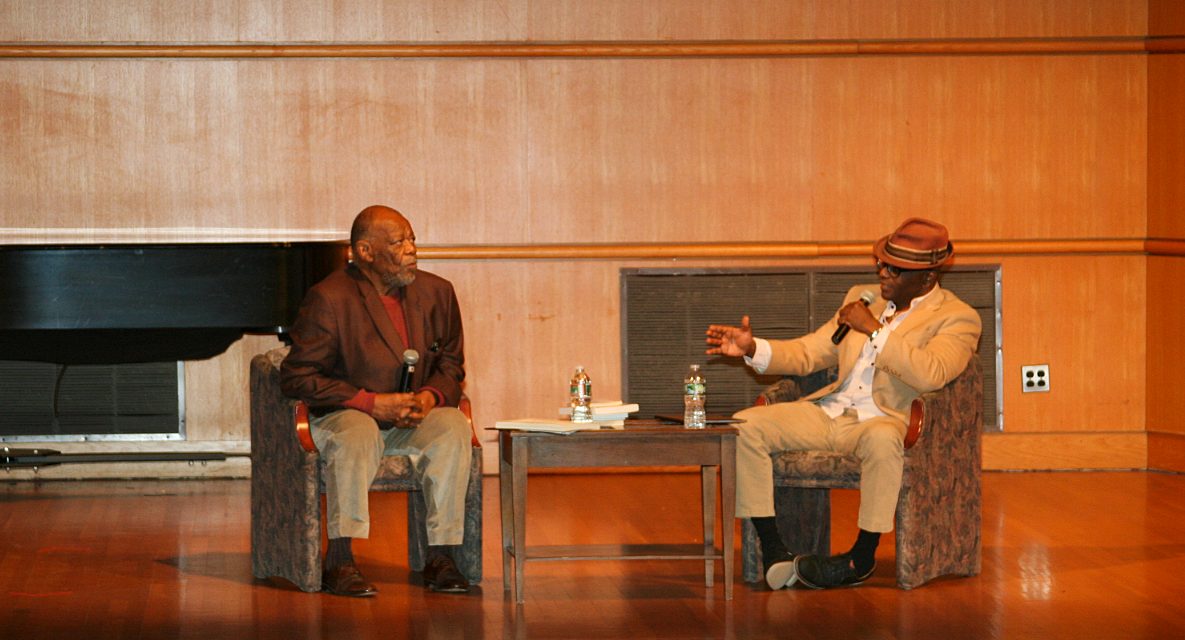
Recently, the College of Staten Island had the honor of hosting Poet Laureate of South Africa Mongane Wally Serote in the 1P Recital Hall. The event was held by CSI’s English Department with faculty member Professor Tyehimba Jess, who won a Pulitzer Prize in 2017, speaking with Serote.
The event began with some jazz, courtesy of Professor Jess; he specifically played a South African jazz artist whom he learned about from Serote. He later explained more about the poet and how he was a critical part of movement against the apartheid regime in South Africa in the 1960s. Jess also explained some of the struggles that the poet faced because of Serote’s activism, such as being arrested under apartheid regime’s Terrorist Act. Afterward, Serote spent nine months in solitary confinement.
Professor Jess also told participants in attendance how Serote eventually left South Africa to attend Columbia University in NYC. Later, he wrote his first book, Yakhal’Inkomo,which won a Pulitzer Prize. During that time of exile that ended in 1990, the poet didn’t just write, he was also involved with anti-apartheid groups. His writing continued to win awards and his book was named one of the 100 best books of the 20th Century. Serote also served as a chair in parliament for South Africa after his return from exile.
After the introduction, the poet greeted the audience and spoke about how he became a poet and his influences, specifically his grandmother. He then read some of his poems “City Johannesburg” and “Alexandria,” and spoke deeply about them to those in attendance. He noted that it is the 50-year anniversary after the Soweto massacre, and how it affected his writing.
He explained that he knew he would write poetry because he knew from an early age that the treatment of black people in South Africa was wrong and that he wanted to represent them. He also explained how it took him three years to publish his book due to many publishers fearing that it would be banned.
A Q&A period followed so the audience could ask about his writing and his life. The participants were all enthusiastic and happy to learn more about him and his story.
By Rachel Rodrigues