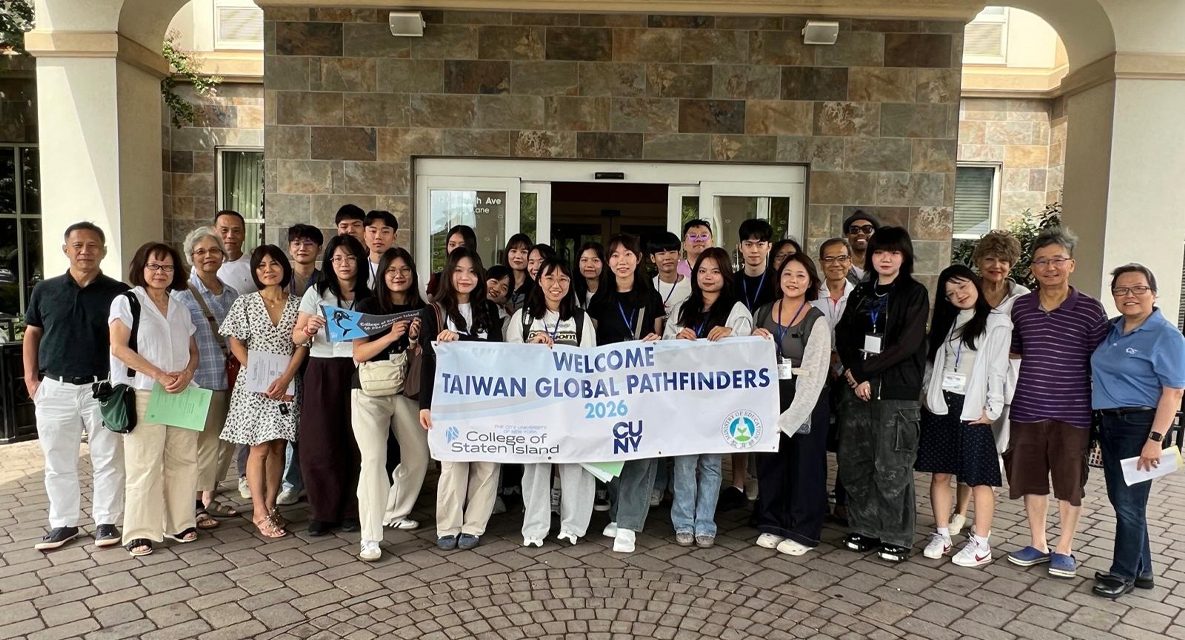
For 20 young scientists from Taiwan, this summer offered much more than a chance to spend time in a laboratory. It was an opportunity to ask questions, try something new, meet people from another culture, and begin imagining what might be possible for their own futures.
Through the Taiwan Global Pathfinders Initiative, participants aged 18 to 30 came to the College of Staten Island for an immersive, hands-on training experience in advanced biomedical science and biotechnology. Supported by Taiwan’s Ministry of Education, the program combines intensive scientific instruction with cultural exploration and opportunities to experience life in New York City.
Over the course of the program, participants received specialized training across nine areas of biomedical and biotechnology research. Rather than simply learning about advanced scientific techniques from a textbook or lecture, participants worked directly with equipment and laboratory procedures under the daily supervision of CSI faculty and researchers.
That hands-on approach was at the heart of the experience.
Participants practiced advanced laboratory techniques while developing rigorous scientific methodologies and gaining a deeper understanding of experimental design. Daily discussions and feedback allowed them to ask questions, troubleshoot challenges, and understand not only how a technique works, but why it matters.
“The CSI Taiwan Pathfinders Program presents a unique opportunity for early-career Taiwanese researchers to engage in top-level training in CSI’s premier laboratories. Each participant will come away from this experience with a newfound appreciation for and greater technical knowledge of the cutting-edge research at the College,” said Dr. Stephen Ferst, Director of CSI’s Center for Global Engagement. “By engaging in this experience, the Taiwanese will return home with a stronger skillset to apply to their future and development of Taiwan. In addition to the work in the laboratory, the participants are exposed to American life and culture and will certainly be inspired to continue to develop the strongest relationships between Taiwan and the United States.”
The program also placed an emphasis on giving participants ownership of their work. Using data collected during their training, each participant is encouraged to develop an individual research project, taking responsibility for the process from experimental design through execution and analysis.
That progression, from following an established procedure to designing and thinking through a project of their own, can be an important step for young researchers considering careers in biomedical science, biotechnology, or related fields.
And while the lab was a major part of their summer, it wasn’t the only place where learning happened. Outside CSI’s laboratories, participants explored New York City and experienced the region’s culture through excursions and group activities. They had the opportunity to see some of the city’s most recognizable destinations while experiencing a place that, for many, was very different from home.
Perhaps more significantly, participants stayed with host families on Staten Island, and living with local families gave the students a window into everyday American life that a traditional study-abroad experience might not provide. Meals, conversations, neighborhood experiences, and the ordinary routines of family life became opportunities for cultural exchange.
For their hosts, the experience offered something in return: a chance to welcome young people from Taiwan into their homes and learn about another culture through personal connections.
“The Taiwan Global Pathfinder Program is a unique initiative through which the Taiwanese government supports youth career development, and we were honored to receive this grant, which allows us to bring 20 Taiwanese participants to CSI for biomedical and biochemical research training this summer,” said Dr. Chang-Hui Shen, Professor and Chair of Biology at CSI. “This exclusive international collaboration offers an excellent opportunity to showcase the research of CSI faculty.”
The Initiative reflects a growing understanding that the next generation of scientists needs more than technical expertise—they also need opportunities to collaborate across cultures, approach problems from different perspectives, and understand their work within a global scientific community.
Co-sponsoring the program is CSI’s Department of Biology and the Center for Global Engagement.