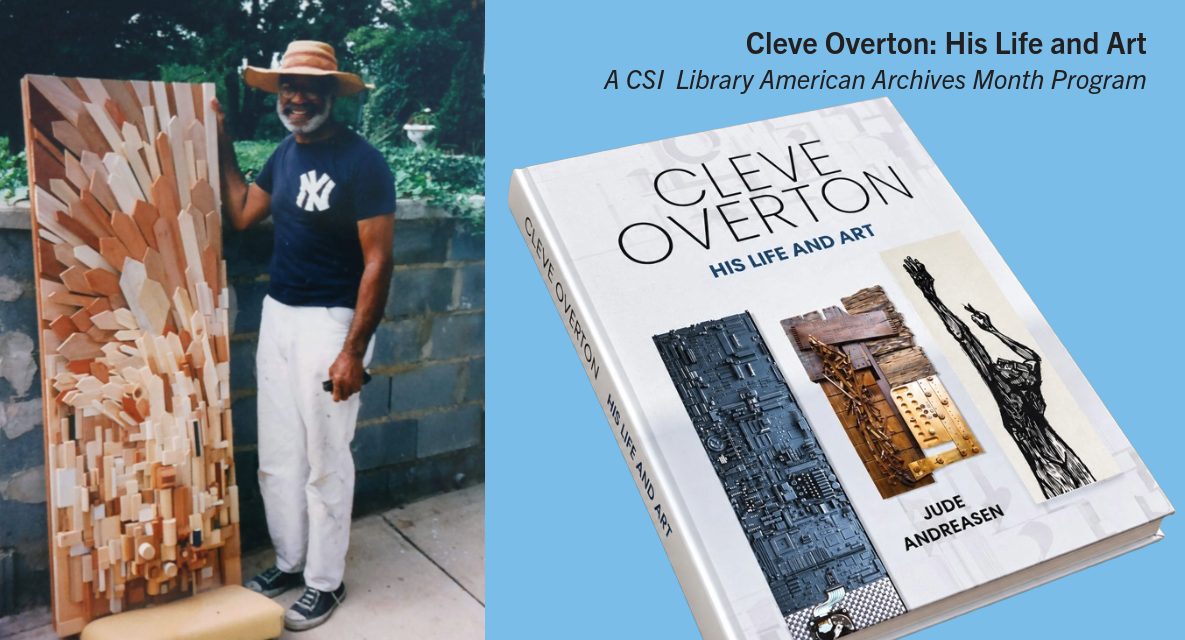
Recently, the College of Staten Island’s Archives and Special Collections held a program about artist Cleve Overton with author Jude Andreasen, speaking about his life and art. The program managed to draw a big crowd with some students attending, but also many of Overton’s personal friends and family in the audience.
Jude Andreasen began the program by speaking about her book that she wrote about Overton, and how it took her several years to finish. She then began to speak about his early life and how he grew up here on Staten Island and later joined the Army. Through his service, he was able to study art through the GI Bill.
Overton was also very interested in politics and wanted to stop discrimination against African Americans. He did this through organizing Black workers and doing advocacy. Andreasen spoke about the mural controversy here on Staten Island that was a big issue for Overton. At Borough Hall, there was a mural that had a poor depiction of a young African American boy, who was a slave. Overton, alongside many others, protested the mural. While some may have forgotten, Overton did not, even when he moved away from Staten Island, he did not stop his advocacy. He continued for years to protest the mural and inform others about it, showing his dedication to the issue.
Overton was not just passionate about his political work, he also was enthusiastic about his art and teaching. Some in attendance at the event even attended the classes he taught at Staten Island Community College, a precursor institution of the College of Staten Island. Past students spoke fondly of their time in his pottery class and still have some of the pottery they made back then.
He also had a lot of businesses in the past and made things for many people throughout Staten Island. One man who came to the program spoke about the many things that Overton had made for him throughout the years and noted that they knew one another. He had made many steel fences, some of which are still standing throughout the Island.
Andreasen also spoke about the evolution of his work, how he went from collecting wood scraps in DC from the trash of a nearby store to collecting electronic materials to use in his art. She told the audience of Overton’s hate for waste and how he always found things he could use for his art, doing so in environmentally friendly ways.
And lastly, Andreasen discussed the traveling that they did together in Africa and how even abroad in a country whose language he did not know, he still had a love of teaching others.
The program ended with those who knew Cleve Overton sharing the ways in which he impacted their lives and made them better, as well as how he had inspired them not only as people but as artists.
By Rachel Rodrigues