From Professor Raja’s AI-guided approach to medicine to a showcase in our Maker Space, ten of Brazil’s top young engineers are spending six weeks learning from CSI faculty.
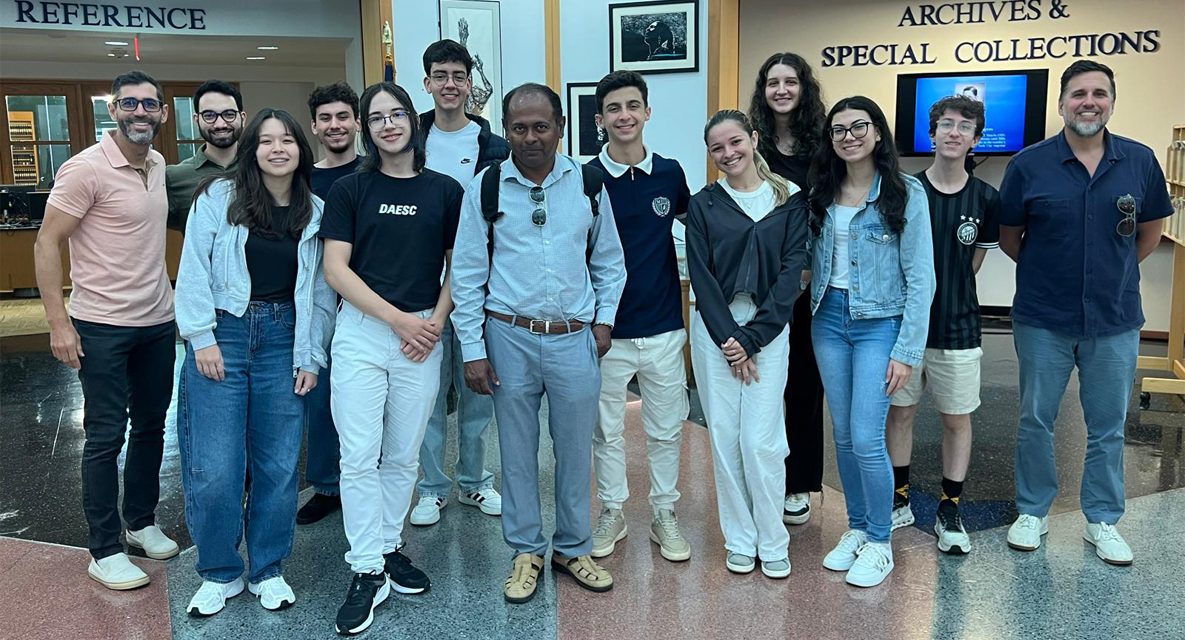
When Professor Krishnaswami Raja opened this summer’s Paraná Talents around the World lecture series, he showed the visiting students something few expect from a chemistry talk: how AI-driven search and molecular-combination tools can be paired with the world’s oldest medicinal traditions — including Indigenous knowledge, such as the use of Amazonian compounds — to discover new treatments. Drawing on his own turmeric-derived wound-treatment compound, Raja walked them from first concept, through research, to the pivot that finally made it work — showing students how broadly they might define their own paths. For Gustavo, one of the ten students, the message landed: he says it has him imagining his future with a more open mind.
Days later, the group moved into CSI’s MakerSpace — a recent addition to campus, focused on supporting innovation and new business growth — where Professor Dimitrios Pavlidis led a showcase of its capabilities, supported by Tracy J. Campbell, who oversees the space. Students used 3D printing to prototype their own ideas and a wind-turbine tester to study the forces acting on structures like drone propellers, learning firsthand how a rough concept becomes proof-of-concept research.
Between lectures, the cohort takes English as a New Language classes every Monday and Wednesday — designed to make the Tuesday and Thursday lectures more comprehensible, and campus and city life more accessible. And there is more still to come: Professor Susan Imberman will lead sessions on designing a “Robot for Good” and on ethical AI and robotics; Professor Lisa Manne will show how satellite-tracking data reveals the migration patterns of birds; and Professor Ping Shi will introduce data science and large language models, along with an overview of CSI’s computer science curriculum.
Three more lectures are still ahead. Astrophysicist Dr. Charles Liu will take the students from colliding galaxies to the star-formation history of the universe; Dr. Jane Alexander, a geologist whose fieldwork maps Staten Island’s own shoreline, will lead a beach field trip on how the coast responds to storms; and biologist Seth Wollney will speak on “Big Data in Biology” — making sense of genome-sequencing data — the intersection of computer science and biology.
The stakes here are high because of the program’s international dimension. The Paraná Talents around the World Mobility program is a pioneering, fully funded initiative of the Brazilian state of Paraná, and this is its very first cohort. The ten students earned their places through a rigorous multi-stage selection and were personally received by the governor before leaving Brazil, with their state covering everything from airfare to tuition. Paraná chose CUNY in part for its record of 13 Nobel laureates — and chose CSI specifically because its English Language Institute won the program through a competitive international proposal. ELI Director Christian Perticone was confident from the start that CSI’s wealth of faculty talent would carry the bid to a winning proposal. The connection was brokered by EducationUSA, the U.S. Department of State’s advising network, which makes what is unfolding here, in a very real sense, a form of diplomacy.
That diplomatic groundwork is already being laid on our campus. Adriano Machado, International Relations Adviser at Universidade Estadual do Centro-Oeste, is working with Winnie Brophy and Christian Perticone — of CSI’s Phi Beta Delta chapter and the Center for Global Engagement — toward a visit from the head of Paraná’s university system and a possible agreement on joint research and student mobility between two strikingly similar public systems. “We can’t wait to build with them — a university system similar in size and scope to CUNY,” says Brophy. Machado sums up the mood simply: “Everything is going so well. We’re so happy with the lectures and classes.”
Photo caption: Prof. Krishnaswami Raja (center) with the Paraná Talents Cohort members
By Christian Perticone